Understanding Distributed Storage Solutions
Modern businesses require distributed storage that can handle massive amounts of data without compromising speed or reliability. Understanding the unique architecture of these storage solutions helps you optimize your IT infrastructure and storage servers effectively.
What are GlusterFS and Lustre?
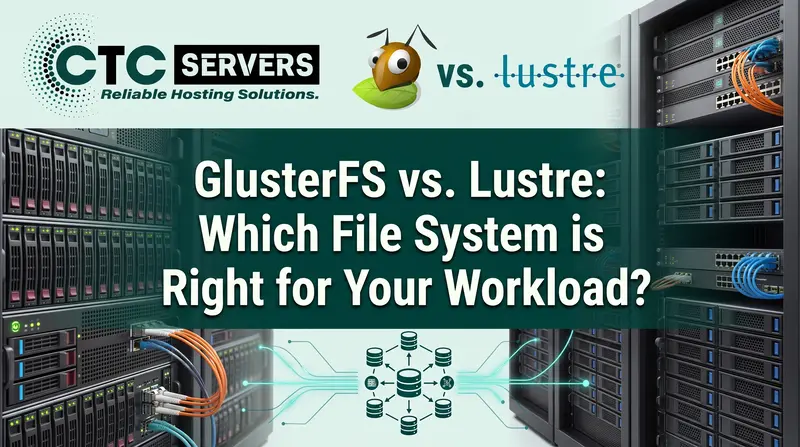
GlusterFS is a free and open-source scalable network filesystem. Using common off-the-shelf hardware, it allows you to create large, distributed storage pools designed for media streaming, data analysis, and other bandwidth-intensive tasks. By connecting multiple storage dedicated servers over a network, GlusterFS provides a unified and highly available storage environment without requiring expensive or highly specialized equipment.
The Lustre file system is an open-source, parallel file system that supports the extreme requirements of leadership-class High Performance Computing (HPC) simulation environments. Unlike traditional setups, Lustre separates metadata from actual file data, allowing thousands of client nodes to read and write simultaneously. This unique architectural design makes Lustre the preferred choice for supercomputers and intense scientific workloads where throughput speed is critical.
Core Features and Benefits
1 Hardware Flexibility
GlusterFS keeps infrastructure costs down by running efficiently on standard, off-the-shelf storage dedicated servers.
2 HPC Optimization
Lustre is engineered specifically for High Performance Computing, delivering unmatched parallel processing speeds.
3 Metadata Handling
Lustre relies on dedicated centralized metadata servers, while GlusterFS utilizes an elastic hashing algorithm to locate data dynamically.
4 Ultimate Scalability
Both are highly scalable network filesystems, easily expanding to manage petabytes of distributed storage as your data grows.
5 Deployment Simplicity
GlusterFS is widely recognized for being easier to deploy, configure, and maintain on standard dedicated servers.
6 Target Workloads
GlusterFS is ideal for content delivery and backups, whereas Lustre rules advanced scientific modeling, AI, and simulations.
Analyzing Performance Architectures
When evaluating performance for your storage dedicated servers, the system architecture plays a major role. GlusterFS relies on an algorithmic approach to file placement, meaning it does not need a dedicated metadata server. This intelligent design eliminates a potential network bottleneck and simplifies the overall management of your distributed storage pool.
Conversely, Lustre utilizes a highly specialized and separated architecture containing Metadata Servers (MDS) and Object Storage Servers (OSS). This strict separation allows complex supercomputing clusters to access massive datasets at the exact same time without interrupting each other. While this requires more technical planning to set up, it delivers the raw throughput needed for the world's most demanding digital workloads.
Direct Comparison Matrix
To make an informed decision for your dedicated servers, it helps to view the core differences side by side.
| Feature |
GlusterFS |
Lustre |
| Primary Focus |
Distributed scalable storage |
High Performance Computing (HPC) |
| Hardware Required |
Common off-the-shelf servers |
Specialized clustered hardware |
| Data Placement |
Elastic hash algorithm |
Centralized Metadata Server (MDS) |
| Setup Complexity |
Simple to moderate |
Highly complex |
| Best Use Cases |
Media streaming, cloud data |
Supercomputing, scientific simulations |
Important Storage Considerations
Keep these vital factors in mind before deploying either filesystem on your network.
- Workload Type: Analyze if your daily tasks involve general data storage (GlusterFS) or heavy, parallel scientific computing (Lustre).
- Budget: GlusterFS utilizes standard hardware, making it much more cost-effective for growing businesses.
- IT Expertise: Lustre requires advanced technical knowledge to architect, configure, and maintain properly.
- Future Growth: Both systems allow you to scale out, but you must ensure your chosen system aligns directly with your long-term expansion goals.
Making the Right Choice for Your Servers
The choice between GlusterFS and Lustre ultimately comes down to your specific operational goals. If you need a flexible, budget-friendly, and highly scalable network filesystem for general data processing and backups, GlusterFS is the smart path. It allows you to build a reliable network using standard hardware without unnecessary complications.
However, if your organization runs high-level simulations, machine learning algorithms, or requires a true parallel file system for supercomputing, Lustre is the undisputed champion. It is built to push the extreme limits of data transfer speeds, ensuring that your massive processing clusters never have to wait for the data they need.
Experience the storage dedicated servers CTCservers
Finding the right hardware to support your distributed storage is just as important as choosing the software itself. At CTCservers, we provide high-quality infrastructure designed to handle intense data loads effortlessly. Our servers are built with top-tier components to ensure maximum uptime, speed, and reliability for your network filesystems.
Whether you decide to deploy GlusterFS for media delivery or Lustre for a heavy-duty computational cluster, our team is ready to support your vision. We offer customizable hardware solutions that fit the exact requirements of your storage architecture, giving you a solid foundation for your digital growth.
- High-Speed Connectivity: Enjoy lightning-fast network ports designed to support massive and continuous data transfers.
- Customizable Hardware: Tailor your hard drives, RAM, and processors to meet your specific storage capacity needs.
- 24/7 Expert Support: Our dedicated team is always online to ensure your servers operate flawlessly around the clock.
Partnering with a reliable hosting provider ensures that your storage solutions perform exactly as intended. CTCservers delivers the power, security, and scalability required to run modern filesystems with absolute confidence.
Are You Ready to Upgrade with CTCservers?
Take your data management to the next level by deploying your filesystem on our powerful hardware today.