The Infrastructure Shift
Modern AI applications require massive datasets to be processed quickly, pushing traditional storage solutions to their limits and necessitating cloud-native architectures that can scale horizontally.
What is MinIO?
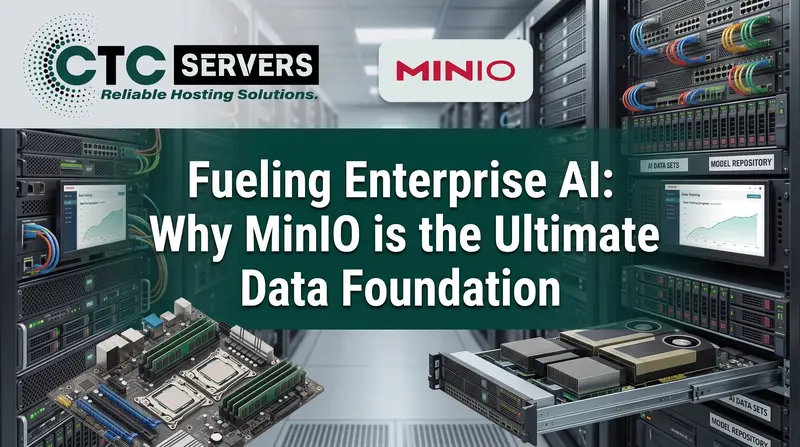
MinIO is a high-performance, Kubernetes-native object storage suite designed specifically for the cloud-native era. Fully compatible with the Amazon S3 API, it serves as a scalable data foundation that efficiently manages both structured and unstructured data. By operating seamlessly across public clouds, private clouds, and hybrid environments, MinIO provides developers with a consistent and reliable storage layer regardless of the underlying infrastructure.
Built to handle intensive AI and machine learning workloads, MinIO is engineered to maximize throughput and minimize latency. In highly-tuned enterprise environments utilizing top-tier NVMe drives and specialized RDMA networking, MinIO can achieve extraordinary throughput rates. This capability ensures that GPU clusters remain continuously fed with data, reducing idle time and accelerating the training and inference processes for complex AI models.
Key Features Empowering AI Workloads
1 AI-Ready Lakehouse
MinIO consolidates diverse data types into a unified, governed foundation, making it easier to manage data lakes and power analytics engines without creating silos.
2 Cloud-Native Architecture
Designed natively for Kubernetes, MinIO scales effortlessly across any cloud or on-premises environment, ensuring maximum flexibility and avoiding vendor lock-in.
3 High-Speed Throughput
Engineered for performance, MinIO utilizes optimized read/write operations to keep demanding AI inference and training engines consistently fed with data.
4 Enterprise-Grade Security
Security features include object immutability, in-transit and at-rest encryption, and strict identity and access management to protect sensitive enterprise knowledge.
5 Strict S3 Compatibility
With comprehensive Amazon S3 API support, MinIO integrates instantly with a massive ecosystem of AI tools, data frameworks, and existing applications.
6 Agentic Memory Support
MinIO can serve as a persistent memory layer for AI agents, allowing models to retain context and build upon previous interactions effectively.
Why MinIO Thrives on Dedicated Servers
While MinIO is fundamentally cloud-native and powers massive deployments across major public clouds, running it on dedicated bare-metal servers offers distinct architectural advantages for specific high-performance use cases. Dedicated servers provide direct, unmediated access to underlying hardware resources like NVMe drives and high-bandwidth network interfaces. By removing the hypervisor and virtualization layers typical in shared environments, organizations can extract maximum I/O performance and achieve highly predictable latency, which is essential for data-heavy AI training.
Furthermore, leveraging dedicated servers for MinIO allows enterprises to build tailored storage clusters that align precisely with their networking and compute needs. Organizations dealing with massive data gravity can bypass the unpredictable egress fees sometimes associated with public clouds by maintaining their own hardware. This approach gives engineering teams total control over their data stack, enabling them to finely tune their network and storage topologies to support high-throughput, AI-driven applications.
Deployment Environments Compared
Choosing where to deploy MinIO depends entirely on an organization's specific requirements regarding hardware control, scalability, and budget.
| Feature |
Dedicated Bare-Metal Servers |
Public Cloud Environments |
| Hardware Access |
Direct access to underlying NVMe and CPU resources |
Abstracted hardware managed by the provider |
| Performance Profile |
Highly predictable latency with no virtualization overhead |
Highly scalable with potential shared-resource variability |
| Cost Structure |
Fixed hardware costs and predictable bandwidth usage |
Pay-as-you-go pricing with variable data egress costs |
| Management Focus |
Requires in-house hardware and network management |
Offloads physical infrastructure maintenance to the provider |
Best Practices for High-Performance Storage
To achieve the best possible performance from a MinIO deployment, specific architectural guidelines should be followed.
- Utilize local, directly attached NVMe storage configured in a "Just a Bunch of Disks" (JBOD) setup rather than complex hardware RAID arrays.
- Implement high-speed networking, such as 100GbE or InfiniBand, to prevent the network from becoming a bottleneck during large data transfers.
- Ensure multiple identical nodes are used to create a distributed cluster, maximizing both throughput and data resilience via erasure coding.
- Dedicate the server resources entirely to the MinIO object storage process to avoid performance degradation from noisy neighbor applications.
Maximizing AI Data Pipelines
To train modern large language models efficiently, organizations must ensure their GPUs are not bottlenecked by storage I/O limits. MinIO addresses this by maintaining a lean, highly optimized software architecture that delivers data quickly and reliably. By streamlining the data path, organizations can keep their expensive GPU clusters highly utilized, which maximizes the return on compute investments and significantly speeds up project timelines.
When deployed in a well-architected environment with the appropriate networking and storage hardware, MinIO enables rapid checkpointing for massive foundation models. This means data scientists can save and retrieve complex model states in seconds rather than minutes. Ultimately, a properly configured MinIO cluster ensures that storage infrastructure becomes an enabler of AI innovation rather than a limiting factor.
The Foundation for AI Inference
Inference requires a different performance profile than training, often demanding ultra-low latency to provide real-time responses to users. MinIO excels here by allowing AI applications to persist and retrieve context quickly, preventing the system from constantly having to recompute data. This efficient memory handling is critical for building intelligent agents that can engage in long-form, context-aware tasks without suffering from lag.
Whether deployed in a multi-cloud Kubernetes cluster or on optimized dedicated hardware, MinIO provides the foundational memory layer needed for these agentic workflows. By standardizing on a reliable object store, organizations can ensure that their AI models have secure, governed, and instant access to the enterprise data required to deliver accurate insights.
- Standardizes AI application development through universal S3 API compatibility.
- Provides a secure, governed repository for storing AI training datasets and inference context.
- Adapts seamlessly to hybrid, multi-cloud, and bare-metal environments without application rewrites.
Ultimately, building a future-proof AI architecture requires software that is both highly performant and incredibly flexible. MinIO provides exactly that, allowing enterprises to scale their data infrastructure efficiently, regardless of where they choose to deploy it.
Build Your Data Foundation
Explore how robust dedicated infrastructure can support your high-performance MinIO deployments and AI workloads.