The Complexities of GPU Programming
Writing highly efficient code for modern GPUs has traditionally been a daunting task, requiring a deep understanding of hardware architecture and manual memory management.
What is OpenAI Triton?
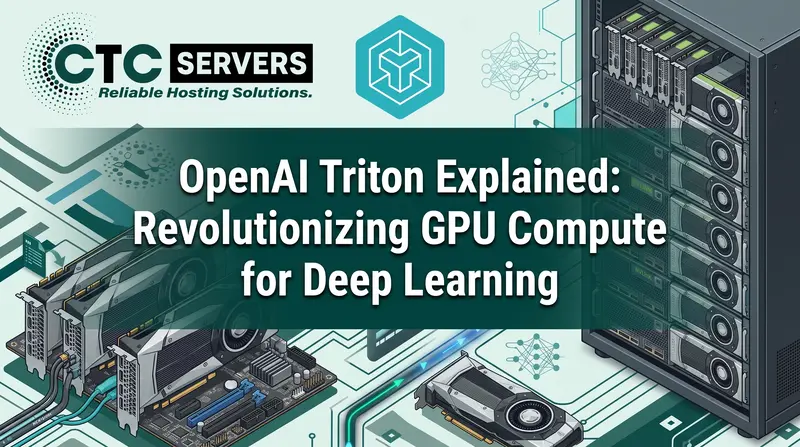
OpenAI Triton is an open-source, Python-like programming language designed specifically to enable researchers with no CUDA experience to write highly efficient GPU code. In the rapidly evolving field of deep learning, implementing novel research ideas often involves combining native framework operators. While this is convenient, it can create temporary data bottlenecks that hurt the performance of neural networks at scale. Triton steps in to solve this issue by making it straightforward to write specialized GPU kernels that perform on par with code written by seasoned experts.
One of the most significant barriers in traditional GPU programming is managing the architecture of modern GPUs, which involves DRAM, SRAM, and ALUs. Developers usually have to meticulously optimize memory transfers, manually manage shared memory banks to prevent conflicts, and carefully partition computations across Streaming Multiprocessors (SMs). OpenAI Triton abstracts much of this difficulty away, automating critical optimizations so developers can focus entirely on the high-level logic and structure of their deep learning applications.
Key Capabilities of OpenAI Triton
1 Open-Source Accessibility
Triton is a completely open-source tool, encouraging community collaboration and making advanced GPU programming accessible to machine learning developers everywhere.
2 Python-Like Syntax
With a syntax closely resembling Python, Triton significantly lowers the learning curve compared to complex, low-level programming languages.
3 Automated Optimization
It automatically handles intricate optimizations such as memory coalescing and shared memory management, reducing human error and saving time.
4 Peak Hardware Performance
Developers can easily reach maximum hardware efficiency, writing operations like FP16 matrix multiplications that seamlessly match expert-level performance.
5 Custom Flexibility
Unlike rigid frameworks, Triton offers developers the flexibility to write custom, specialized kernels for complex element-wise operations and reductions.
6 Block-Level Concurrency
Triton utilizes operations on multi-dimensional blocks rather than standard thread execution, streamlining intra-instance parallelism for faster compute.
The Programming Model of Triton
At its core, the programming model of OpenAI Triton shares similarities with domain-specific compilers where kernels are defined as decorated Python functions and launched concurrently on a grid. However, Triton distinguishes itself by exposing intra-instance parallelism through operations on small arrays or blocks whose dimensions are powers of two. This block-centric approach effectively abstracts away the notorious concurrency issues found in standard GPU programming, such as thread synchronization, memory coalescing, and tensor core scheduling.
This unique structure makes Triton incredibly powerful for complex GPU programs. For instance, when implementing a fused softmax kernel, standard methods require explicit and challenging thread synchronization. With Triton, each kernel instance simply loads the required data row and normalizes it sequentially using straightforward, NumPy-like primitives. This keeps the data in SRAM throughout the process, maximizing data reuse and significantly outperforming general-purpose deep learning libraries.
CUDA vs. Triton Comparison
To fully understand how Triton revolutionizes GPU compute, it is helpful to look at how it compares to traditional CUDA programming when handling essential performance optimizations.
| Feature |
CUDA |
OpenAI Triton |
| Memory Coalescing |
Manual |
Automatic |
| Shared Memory Management |
Manual |
Automatic |
| Scheduling (Within SMs) |
Manual |
Automatic |
| Scheduling (Across SMs) |
Manual |
Manual |
Advantages for Deep Learning Researchers
By bridging the gap between high-level application logic and low-level hardware performance, Triton offers distinct advantages for building scalable neural networks.
- Faster Development Cycles: Researchers can write complex GPU kernels in just a few lines of code (such as building matrix multiplication kernels in under 25 lines), drastically accelerating iteration.
- Improved Efficiency: Kernels created with Triton can be up to twice as efficient as equivalent implementations found in standard deep learning frameworks like PyTorch.
- Reduced Boilerplate Code: By fully automating memory management, Triton eliminates the need for verbose, difficult, and error-prone optimization code.
- Focus on Algorithmic Logic: Developers retain control over important high-level algorithmic decisions, such as inter-SM synchronization and tiling, without getting bogged down by hardware micro-management.
Under the Hood: High-Level Architecture
The remarkable performance of OpenAI Triton stems from its highly modular system architecture, which is centered around Triton-IR, an LLVM-based intermediate representation. In this architecture, multi-dimensional blocks of values are treated as first-class citizens. When a Python function is provided, Triton dynamically generates this intermediate representation by walking the Abstract Syntax Tree, ensuring that the code is structured directly for modern GPU operations.
Once the Triton-IR is generated, the sophisticated compiler backend takes over the heavy lifting. It simplifies, optimizes, and automatically parallelizes the code before converting it into high-quality LLVM-IR, and eventually PTX, for execution on recent hardware. This allows the compiler to automatically manage data stashing and intelligently partition computations across different SIMD units, delivering expert-level execution speeds straight out of the box.
Experience the GPU dedicated servers at CTCservers
To truly leverage the ground-breaking capabilities of open-source tools like OpenAI Triton, you need hardware that can keep up with your intensive computational demands. At CTCservers, we provide top-tier GPU dedicated servers engineered specifically to accelerate your most demanding deep learning and machine learning workloads. Whether you are training complex neural networks, analyzing massive datasets, or running custom Triton kernels, our servers deliver the raw power and uncompromised performance your projects require.
We understand that in the fast-paced world of artificial intelligence and machine learning, uptime, network speed, and reliability are critical to your success. That is why our GPU dedicated servers are housed in secure, advanced data centers backed by enterprise-grade network connectivity. When you choose CTCservers, you are not just renting hardware; you are investing in a robust, scalable infrastructure designed to turn your most ambitious AI research into reality without the bottleneck of slow computation.
- Unmatched Performance: Gain access to the latest, high-performance GPUs designed to handle massive data processing and advanced deep learning workloads seamlessly.
- Reliable Uptime: Benefit from our enterprise-grade infrastructure that guarantees exceptional stability, minimal latency, and continuous availability for your critical applications.
- Scalable Solutions: Easily scale your server resources up or down depending on the demands of your current projects, ensuring cost-effective and flexible computing power.
Maximizing your computational efficiency has never been easier. By combining modern software programming solutions like OpenAI Triton with the raw, uncompromising hardware power of CTCservers' infrastructure, you position your projects at the absolute forefront of artificial intelligence innovation.
Are You Ready to Upgrade with CTCservers?
Take your deep learning projects to the next level with our ultra-fast and reliable server solutions today.